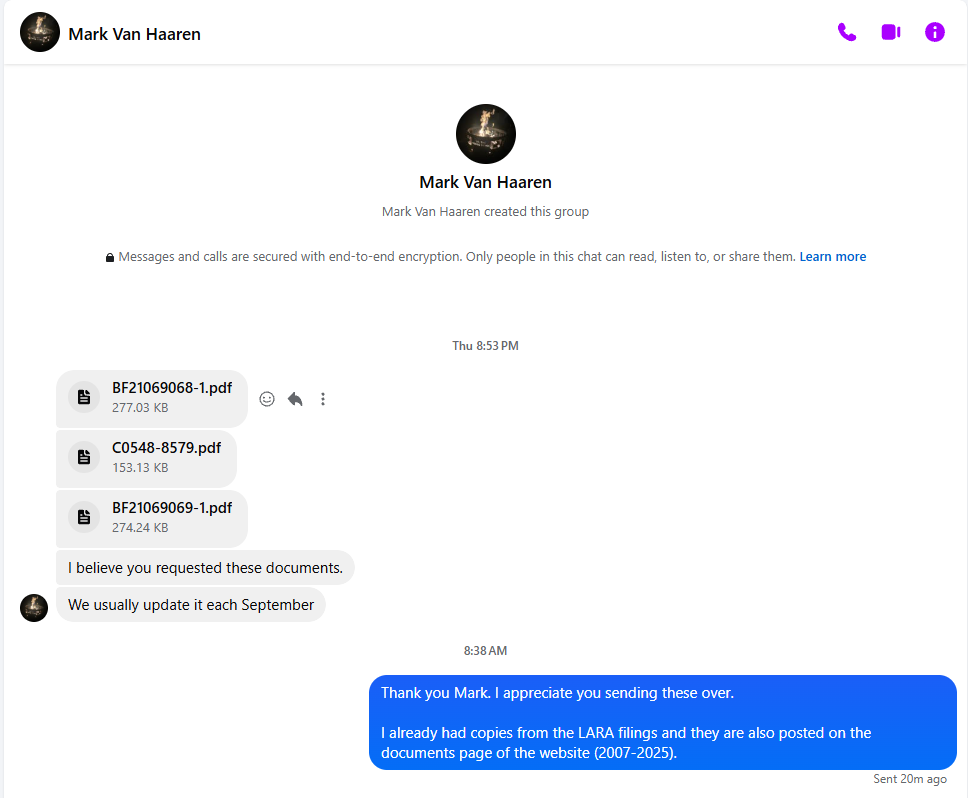
Governance Concern
Review of Association Records

Legal Requirement to Maintain Association Records

Michigan Legislature‘s nonprofit corporation laws require nonprofit corporations to maintain certain corporate and financial records and make certain records available for inspection by members.

Under the Michigan Nonprofit Corporation Act, nonprofit corporations are generally required to maintain records such as:

  • Correct and complete books and records of account
  • Minutes of proceedings of members and boards
  • Records of actions taken by members or directors
  • A record of members entitled to vote

Relevant statutory provisions include:

  • MCL 450.2481 — Corporate records requirements
  • MCL 450.2487 — Member inspection rights for certain records
  • MCL 450.2488 — Court enforcement of inspection rights

These statutes exist to help ensure transparency, accountability, and proper corporate governance.

Correct and Complete Books and Records of Account

Under MCL 450.2481, nonprofit corporations are generally required to maintain “correct and complete books and records of account.”

At a minimum, this generally means the Association should be able to produce basic financial records showing how Association money was received, spent, and managed.

These records commonly include:

  • Bank statements
  • Income and expense statements
  • Balance sheets
  • General ledgers
  • Budget reports
  • Check registers
  • Reserve account statements
  • Records of dues and assessments collected
  • Records of expenditures and payments

These records are important because they help establish:

  • What money came into the Association
  • What money was spent
  • Current financial balances
  • Whether expenditures were properly documented
  • Whether financial reporting was accurate

Without these types of records, members may have difficulty understanding the financial condition and operation of the Association.

Minutes of Proceedings of Members and Boards

Under MCL 450.2481, nonprofit corporations are required to maintain minutes of proceedings of members, boards, and committees.

Meeting minutes help establish the official record of Association actions and decisions.

Minutes commonly document:

  • Meeting dates and attendance
  • Whether quorum requirements were met
  • Motions and resolutions
  • Board actions and approvals
  • Membership actions and approvals
  • Financial approvals
  • Discussions relating to governance or restrictions

For significant membership votes — particularly where governing documents require a specific approval threshold such as a two-thirds (2/3) vote — records commonly document:

  • Total votes cast
  • Vote totals for and against proposals
  • Abstentions or proxies
  • Whether the required approval threshold was met

These records are important because they may be necessary to verify that amendments, restrictions, or other major Association actions were properly authorized.

Without documented vote totals and supporting records, it may become difficult to confirm whether required member approval was actually obtained.

Records of Actions Taken by Members or Directors

Under MCL 450.2481, nonprofit corporations are generally expected to maintain records supporting actions taken by members and directors.

Associations operate through documented decisions and approvals. Important corporate actions are typically supported by records showing what action was taken, who approved it, and when it was approved.

These records may relate to:

  • Adoption or amendment of restrictions
  • Approval of budgets or expenditures
  • Special assessments
  • Enforcement decisions
  • Contracts or vendor agreements
  • Insurance coverage decisions
  • Board resolutions
  • Membership approvals

For significant actions, records commonly include meeting minutes, motions, resolutions, vote results, supporting documents, and related correspondence or notices.

These records are important because they help establish whether major Association actions were properly authorized and whether required procedures were followed.

Without supporting records, it may become difficult to verify the authority behind important Association decisions.

Record of Members Entitled to Vote

Under MCL 450.2481, nonprofit corporations are required to maintain a record of members entitled to vote.

Voting records are important because many Association actions depend on valid member approval.

These records commonly help establish:

  • Current membership status
  • Voting eligibility
  • Ownership information
  • Quorum calculations
  • Election participation
  • Approval of amendments or restrictions

For significant membership actions, these records may also help verify whether the required percentage of member approval — such as a two-thirds (2/3) vote — was actually achieved.

Accurate voting records are important because they help establish the procedural validity of Association decisions and actions.

Without reliable membership and voting records, it may become difficult to confirm whether major Association actions were properly authorized.

Right to Inspect Association Records

Under the Michigan Nonprofit Corporation Act, members have inspection rights relating to certain corporate books and records maintained by nonprofit corporations.

MCL 450.2487 provides for the inspection of corporate records maintained by the Association.

These records commonly include:

  • Membership and voting records
  • Meeting minutes
  • Financial records
  • Corporate actions and resolutions
  • Governance records
  • Amendments and restrictions

Inspection rights are important because these records help establish whether Association actions were approved with proper authority and in accordance with the governing documents.

Court Enforcement of Inspection Rights

MCL 450.2488 provides a mechanism for court enforcement of member inspection rights involving nonprofit corporate records.

If requested records are not produced, the circuit court may review issues such as:

  • Whether the requested records exist
  • Whether the records are required to be maintained
  • Whether the member is entitled to inspect the records
  • Whether the request was made for a proper purpose
  • Whether access was improperly denied
  • Whether Association actions can be supported by documentation

Because Association records often establish the official history and authority behind corporate actions, records disputes may become important in determining whether major decisions were properly authorized and documented.

Court enforcement actions involving records may also result in additional review of governance procedures, voting records, financial reporting, amendments, restrictions, and other corporate actions related to the operation of the Association.

How Does a Member Request Records From Pinnacle Estates Association?

Members seeking Association records can submit a written request to the Association by mail.

Requests may be directed to:

P.E.A.
P.O. Box 141
Sterling, MI 48659

A written request helps create a documented record showing:

  • What records were requested
  • When the request was made
  • Whether the Association responded
  • What records were produced
  • Whether any records were denied or unavailable

A sample records request letter is available in the Document Library and may be modified by individual members depending on the records they are seeking and the issues involved.

👉 Download Sample Records Request Letter (MS Word)

Activity Log Related to Records Requests

This section serves as an activity log relating to records requests and related Association activity.

Entries may include records requests, emails, letters, USPS tracking activity, Facebook posts, Association responses, meeting activity, and related supporting documents.

The purpose of this log is to maintain a chronological record of events, communications, and related documentation.

Preface

I placed earnest money on the white house located at the top of Pinnacle Hill.

The property was owned by Larry and Shannon Whyte, but was under the control of their daughter, who was acting as guardian for both parents.

At the time of the transaction, the realtor indicated that there was an association connected to the subdivision, but no information or governing documents were available.

The Whytes communicated that they had no memory of an association and did not have Association documents available to provide.

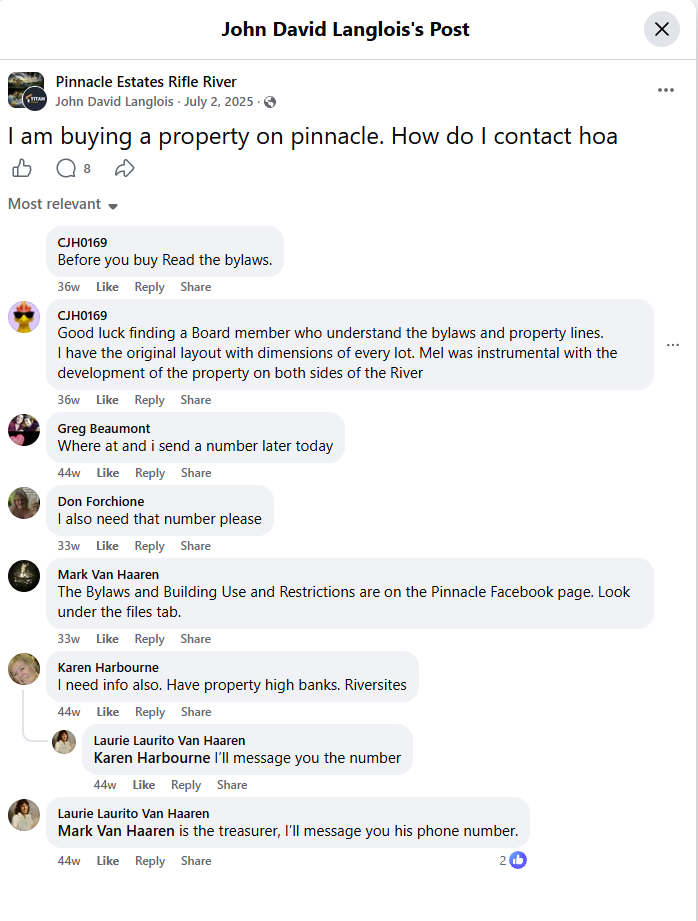
After searching for information for several days, I eventually located a Facebook group associated with Pinnacle Estates, joined the group, and made a post requesting information regarding the Association and its governing documents.

Thank you Laurie Van Haaren.

Karen Harbourne also needed a copy of the documents.

While talking to Mr. Van Haaren he indicated that the documents I was looking for were not available online and that he also could not email them to me as he did not have a digital copy.  I was then given Sharon Williams phone number.  I then called Shannon and she also indicated that she could not email me the documents and would instead mail them to me..  A few days later I received the Bylaws and land use restrictions via snail mail.

11 weeks later Mr. Van Haaren posted that the documents had been added to the Facebook Group Files.
👉 View Supporting Document

Specifically, I am requesting the following:

  • A current list of association members, including names and mailing addresses
  • Copies of IRS Form 990 filings for the past three years
  • Meeting minutes from the past three years
  • Names, addresses, phone numbers and titles of each of the current officers

👉 View Supporting Document

Sharon responds with:

  • An out of date mailing list (I was not included)
  • Minutes from the 2023, 2024 and 2025 Annual Meeting

👉 View Supporting Document

Sharon responds with:

  • Membership Mailing List
    • The mailing list provided did not include my information.
  • Minutes from the 2023, 2024 and 2025 Annual Meetings
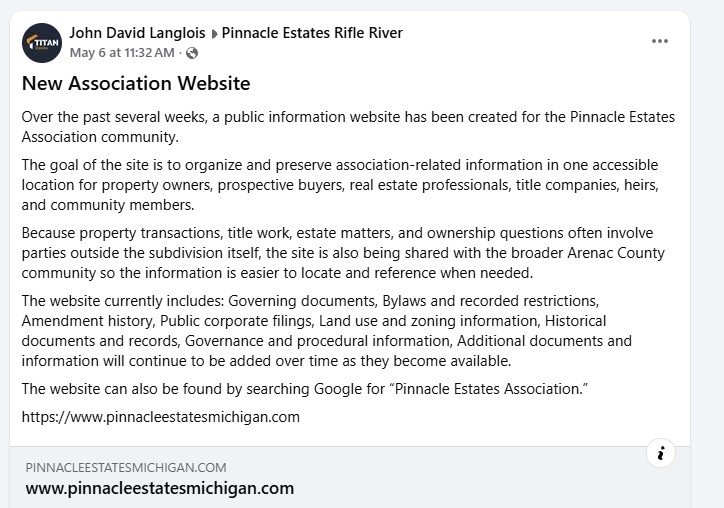
👉 View Supporting Document

—– Forwarded Message —–
From: “Laura Zingalis” <lzingalis@gmail.com>
To: “Sharon Williams” <dmwfam5@yahoo.com>
Sent: Tue, Apr 14, 2026 at 9:48 AM
Subject: Fwd: FW: [External] Fwd: Fw: Follow-Up on Records and Upcoming Annual Meeting
I’d keep to facts and emotions out. Use what you want and remove what you don’t. Trying to keep it simple.
Attached last 3 years of sign in sheets, I’d refer to bylaws for anything contained in there.
1. Membership List
a. Did the seller/seller’s real estate agent not communicate the HOA contact information at the time you
were purchasing the property? They are legally responsible to notify a buyer.
i. HOA membership and obligations are disclosed by the seller as part of
the real estate transaction and recorded in the property’s governing documents. The
Association is not a party to the sale.
ii. The HOA does not automatically learn when a property is sold.
Maintaining accurate ownership records is therefore an ongoing administrative process that
relies on multiple inputs such as recorded deeds, seller/title company notification, including
notification from the new owner. Once notice is received, the updates can be made to the
membership roster.
iii. Your mailing address of 366 Pinnacle Omor, MI. 48749 will be updated to
reflect the proper name of: John Langlois
2. Tax Filings
a. We can provide a copy with the SSN redacted
b. These records are strictly informational
3. Meeting Minutes/Voting Records
a. Attached are the sign in sheets for the past three years.
4. Upcoming Annual Meeting/Elections
a. You attend the annual meeting to participate in voting of new officers and we encourage you to attend.

Summary of Records Produced and Records Still Outstanding

Records Currently Received

The following records have been produced to date relating to Association governance, voting, and records requests.

Membership Meeting Records

  • Membership meeting minutes and sign-in sheets for 2023, 2024, and 2025

These records help document attendance and meeting activity.

The bylaws require voting to occur in person at membership meetings. The bylaws also require the Treasurer to prepare a list of members entitled to vote and require voting members to be checked against that list at the meeting.

Because of that, records relating to voting authority, quorum, and vote totals become especially important.

However, the records produced to date do not establish:

  • Who was eligible to vote
  • Whether voting members were verified against an eligibility list
  • Whether the required quorum of five (5) members was satisfied
  • Total votes cast
  • Vote totals for and against proposed amendments
  • Whether the required two-thirds (2/3) approval threshold was achieved for amendments or major Association actions

No vote tally records or other records documenting how votes were counted and verified have been produced to date.

Annual Report Filings

  • 2023, 2024 and 2025 Annual Reports

These records identify officers and directors reported to the State of Michigan and help document the governance structure reflected in recent filings.

These filings had already previously been obtained through public records searches.

Membership List

  • A membership mailing list was produced

However, the list provided did not include my ownership information and may not reflect current ownership or voting eligibility.

Records Still Outstanding or Not Yet Produced

Amendment and Bylaw Authority Records

The following records relating to bylaw adoption and amendments have not yet been produced:

  • Vote totals
  • Quorum verification
  • Membership eligibility verification
  • Records identifying members entitled to vote
  • Motions or resolutions approving amendments
  • Complete bylaw amendment chain

These records are important because they help establish whether amendments and governance actions were approved with proper authority.

Proper Notice Records

The following records have not yet been produced:

  • Meeting notices for meetings involving bylaw amendments
  • Meeting notices for meetings involving land use restriction changes
  • Proof that notices were mailed, delivered, or otherwise provided
  • Notice dates
  • Notice content
  • Records showing the meeting was called for the purpose of considering and voting upon proposed bylaw or restriction amendments
  • Records showing members were informed what action was being proposed

The bylaws require advance notice to members and require meetings involving amendments to be called for that purpose.

Without notice records, vote totals, voting eligibility records, and quorum verification, it may be difficult to verify whether amendment procedures required by the bylaws were followed.

Board Authority and Board Meeting Records

The following records have not yet been produced:

  • Complete board meeting minutes
  • Records of board elections
  • Appointment records
  • Vacancy records
  • Officer selection records
  • Records relating to board size or composition

The bylaws state that the Board of Directors shall consist of six (6) directors.

These records are important because they may establish the authority for the governance structure reflected in recent annual reports and other Association records.

Financial Records

The following financial records have not yet been produced:

  • Financial statements
  • Treasurer reports
  • Budgets
  • Bank statements
  • Records of assessments collected
  • Records of expenditures
  • Reserve fund records
  • Financial reports presented to members or the board

These records are important because they help establish how Association funds were received, spent, and managed.

Land Use and Enforcement Records

The following records have not yet been produced:

  • Enforcement records
  • Violation records
  • Waiver or variance records
  • Selective enforcement records
  • Records relating to decisions not to pursue enforcement
  • Records relating to camping or short-term rental restrictions

These records may help establish how restrictions and enforcement actions have been interpreted and applied.

Facebook Group and Communication Records

The following records have not yet been produced:

  • Moderation records
  • Member ban or removal records
  • Communication policies
  • Records relating to Association announcements
  • Records relating to Association-related events communicated through the Facebook group

These records may help establish how the Facebook group was used for Association communications and governance-related activity.


Next Steps

Review and organization of the records produced to date remains ongoing.

Additional supporting documents, correspondence, filings, meeting records, notices, and governance-related materials may continue to be added to the activity log and related pages as they are reviewed and organized.

Additional records and clarification are still being requested from the Association. Depending on the response received, additional follow-up requests or formal demand correspondence may be issued.

The ongoing review is focused on determining whether the Association’s governance actions, voting procedures, amendments, financial administration, and related corporate activities can be supported by documented records.